
Offshore accounting services keep the books, payroll, tax filings and financial reporting of a company or structure that operates outside your home country, or that is run by a team located abroad. If you own a company in Panama, a trust or foundation, or a business with bank accounts in several jurisdictions, the best setup is one where the accounting sits next to the formation, banking and legal work instead of being a separate vendor that never sees the whole picture. That is how we run it at 4Corporate: accounting and bookkeeping is delivered as part of one coordinated engagement with company formation, banking introductions and business support.
This guide is for founders, investors, families and companies that need records they can trust across borders. It explains what the work includes, what the main risks are, and how to judge any arrangement before you sign it.
TL;DR
- "Offshore accounting" means two things: accounting for entities and accounts located abroad, and accounting work performed by people located abroad. Many owners need both.
- Routine work such as bookkeeping, payables, receivables, reconciliations and financial statements is commonly handled remotely. Approval of the numbers stays with you or your finance lead.
- The real risks are weak oversight, data security, time zones, insurance gaps and unclear exit terms. Each can be controlled in the contract and the workflow.
- If you are a US person, a foreign company usually brings US reporting duties, so your accountant must know both sides.
- Our accounting and bookkeeping starts from $500 per month and sits inside one engagement with formation, banking and CFO support.
Table of Contents
- What offshore accounting services actually mean
- What gets handled offshore
- Why a coordinated engagement beats stitching vendors together
- What a good setup looks like, step by step
- The risks to control, and how
- How to judge an offshore accounting provider
- Costs and benefits, measured properly
- US owners: what the foreign structure adds
- Regulation is moving toward more oversight, not less
- Where 4Corporate fits
- A simple way to start
- FAQ
- Sources
What offshore accounting services actually mean
The phrase is used loosely, so it helps to separate the two meanings.
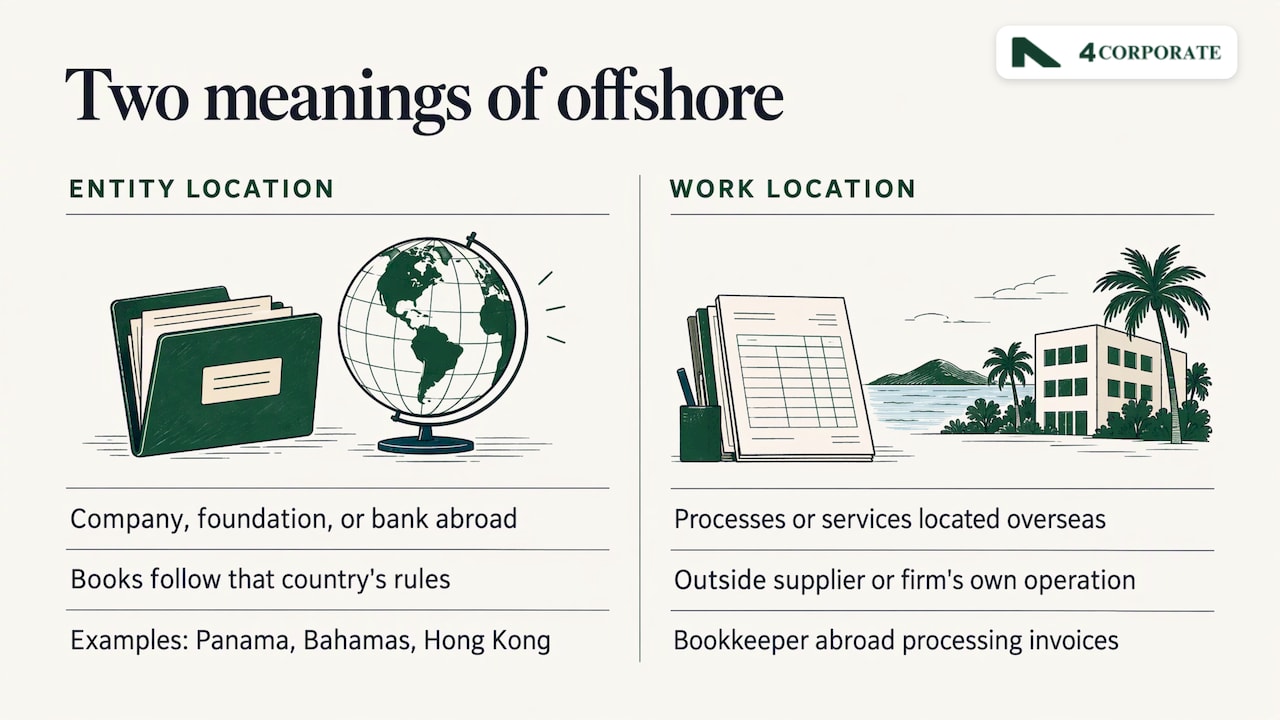
The first is about where the entity is. You have a company, foundation or bank account in another country, and its books must follow that country's rules and still make sense to you at home. A Panamanian corporation, a Bahamas company or a Hong Kong operating business all fall here.
The second is about where the work is done. Australia's Tax Practitioners Board draws the line clearly in its guidance: outsourcing means obtaining a service from an outside supplier, while offshoring means locating processes or services overseas, and offshore work can be done by a third party or by a firm's own overseas operation. A bookkeeper in another time zone processing your invoices is offshoring in this sense, even if your company is domestic.
For an owner with an international structure, the two meanings overlap. The entity is abroad, the bank is abroad, and some of the people doing the work are abroad. What matters is that someone is accountable for the whole chain.
What gets handled offshore
Professional bodies describe the typical scope fairly consistently. ACCA's January 2024 guide lists payroll processing, bookkeeping, accounts payable and receivable, tax preparation, financial-statement preparation and financial analysis or planning among the work that practices commonly outsource overseas.
For a small or mid-sized international business, that translates into a working list:
| Task | What it involves | Who should approve it |
|---|---|---|
| Bookkeeping | Recording transactions, categorizing, reconciling bank and card accounts | Owner or finance lead reviews monthly |
| Accounts payable and receivable | Supplier bills, customer invoices, collections follow-up | Owner approves payment runs |
| Payroll | Salaries, contributions, payslips in the local format | Owner approves totals before release |
| Financial statements | Profit and loss, balance sheet, cash flow | Owner or board signs off |
| Tax and compliance filings | Local returns and statutory reports | Licensed local professional, reviewed by you |
| Audit support | Preparing schedules and records for an auditor | Owner and auditor |
| Planning and analysis | Budgets, forecasts, management reporting | Owner or outsourced CFO |
The pattern is simple: preparation and processing can sit with a remote team, while approval, signatures and decisions stay with the people who own the risk.
Why a coordinated engagement beats stitching vendors together
Most problems with cross-border books do not come from bad arithmetic. They come from gaps between the people involved.
The company was formed by one provider, the bank account was opened through a second, the bookkeeping is done by a third, and the local tax filing by a fourth. Each one sees a slice. When the bank asks why a transfer was booked as a loan, or when a filing needs the incorporation documents, someone has to chase three parties across three time zones.
One coordinated engagement removes most of that friction. The accountant works from the same incorporation documents, knows which bank accounts belong to which entity, and can raise a question with the people who set the structure up. Our positioning is exactly this: we work across mobility, company formation, banking introductions and ongoing business support in one engagement, and licensed advice and services are handled by qualified professionals in the relevant jurisdiction.
In practice, that means the sequence looks like this:
- The company or structure is formed, for example a Panama corporation, which we offer at $2,500 one-off.
- Bank accounts are introduced, such as Panama corporate banking or Hong Kong corporate banking.
- Bookkeeping starts from the first transaction, so there is no year-end cleanup of a messy ledger.
- Reporting, audit support and CFO-level oversight scale up as the business grows.
If you are still deciding on the structure itself, our guide on questions to ask before forming an international company is the place to begin, because the accounting follows the structure you choose.
What a good setup looks like, step by step
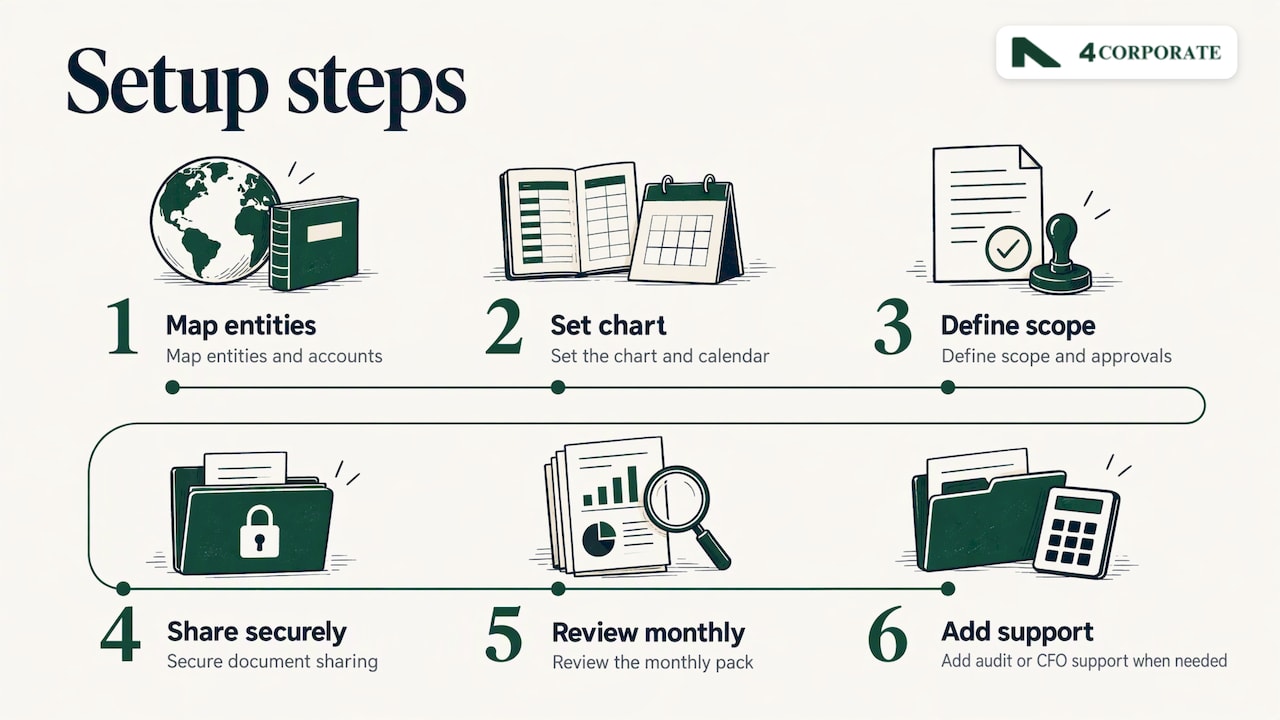
Here is the routine we would recommend for a new or restructured international business, and what usually goes wrong at each step.
Step 1: Map the entities, accounts and currencies
List every legal entity, every bank or payment account and every currency. Note who the owners and signatories are. The most common failure here is an account nobody has told the bookkeeper about, which later appears as unexplained cash movement. When formation, banking and accounting come through one engagement, this map is built once and reused.
Step 2: Fix the chart of accounts and the calendar
Agree how revenue, expenses, intercompany loans and owner contributions are categorized, and set a monthly close date. Owners often skip this and discover at year end that personal and business spending are mixed. Keep owner funds and company funds strictly separate from day one.
Step 3: Choose the scope and who approves what
Decide which tasks are processed for you and which you approve. ACCA's guidance recommends initial due diligence, quality monitoring and approval before sign-off, clear delivery expectations and deadlines, and ongoing relationship management as controls. Translate that into a one-page routine: documents due by the fifth, books closed by the fifteenth, your review within three business days.
Step 4: Set up secure document sharing
Use a shared, access-controlled platform instead of email attachments with bank statements. Decide who can see what, and how access is removed when someone leaves. Weak data handling is the risk owners underestimate most.
Step 5: Review the monthly pack
Read the bank reconciliation, the profit and loss and the list of unusual items. Ask about anything you do not recognize. A short monthly review catches errors while the paperwork is still fresh.
Step 6: Add audit support and CFO oversight when the business needs it
Once there are lenders, investors, several entities or a statutory audit, books alone are no longer enough. That is where audit support and an outsourced CFO fit, using the same records that bookkeeping has kept clean from the start.
The risks to control, and how
Professional guidance is honest about the risks of any cross-border delivery, which is why it is worth building controls in from the start. ACCA's guidance names loss of oversight, communication and time-zone difficulties, security weaknesses, cross-border data-protection issues and changing sanctions status as the main areas.
Here is how each one is handled in a well-run engagement:
- Oversight: a named contact, a monthly close calendar and a sign-off step. You see the numbers every month rather than once a year.
- Time zones: agree a fixed window for questions and a response time. A weekly call is usually enough for a small company.
- Security: access-controlled sharing, limited user rights and a clear process for removing access.
- Data protection: know in which countries your records will be held and who can open them. Australia's tax practitioner regulator, for example, expects practitioners to explain to whom and where client information will be disclosed and generally obtain permission first. Whatever your country, ask the same question.
- Sanctions and jurisdiction changes: a provider that works across several jurisdictions can tell you early when a country's status affects banking or payments.
- Insurance: ACCA notes that offshore delivery can affect professional-indemnity, management-liability, cyber and other cover, and advises discussing the arrangement with your broker and disclosing business changes to insurers. If you carry cyber or management-liability cover, tell your broker when you add an international provider.
How to judge an offshore accounting provider
The Australian Tax Practitioners Board's guidance is written for registered tax practitioners, but its checklist is useful to any owner. It points to competence of the provider, how information is transferred and stored, security controls, backups, oversight, review of output and exit arrangements.
Turn that into questions for the engagement letter:
- Who does the work, and who is licensed? Statutory filings, audits and legal opinions must come from professionals licensed in the relevant jurisdiction. Ask which tasks are done by which person.
- Where is my data held, and who has access?
- What is delivered each month, and by what date?
- How are errors corrected and who bears the cost of a missed deadline?
- What happens at the end? You should be able to take your ledgers, files and access credentials with you in a usable format.
- Can the same team support the next stage? Banking, audit support and CFO-level reporting are easier when they build on one set of records.
Responsibility matters too. The same Australian guidance says a tax practitioner remains responsible for competent services performed on their behalf by an unregistered contractor, including supervision and control. The principle carries over to owners: you cannot hand over accountability for your own company's records. That is why a clear approval step belongs in every setup.
Costs and benefits, measured properly
CPA Australia's guide on outsourcing recommends weighing both qualitative and quantitative costs and benefits. It lists transition, training, recruitment, process standardization, systems and facilities among the cost categories. The same guide names lower operating and software costs, productivity, standardized processes, scalable platforms and better access to management information as possible benefits.
For an owner, the comparison is usually between building an in-house finance function and engaging a team that already has the process. An in-house hire means salary, software, training and cover for holidays. A fixed monthly service means one predictable fee. Our accounting and bookkeeping starts from $500 per month, and the scope above that depends on the number of entities and transactions.
The benefit people feel first is not the saving. It is the monthly rhythm: books closed on time, questions answered, and no panic when a bank or an advisor asks for statements.
US owners: what the foreign structure adds
If you are a US citizen or resident, a company abroad does not take you out of the US reporting system. The IRS notes that certain US citizens and residents who are officers, directors or shareholders in certain foreign corporations must file Form 5471, and that substantial penalties exist for failing to file when it applies.
The practical consequence is that clean, well-organized foreign books are the raw material for those US filings. Whether a particular form applies to you depends on your ownership and the structure, so confirm it with your US tax adviser. What we coordinate is the foreign side: complete ledgers, bank statements, corporate documents and financial statements, ready when your US preparer asks for them, with licensed local professionals handling what must be done locally.
Regulation is moving toward more oversight, not less
Financial centers are tightening the rules for providers. India's International Financial Services Centres Authority, for instance, published a 2024 framework covering book-keeping, accounting, taxation and financial-crime-compliance services, and its FAQ states that providers must meet the applicable AML, CTF and KYC guidelines of the authority.
For you, the lesson is general: banks and regulators increasingly expect documented records and identifiable, qualified people behind the numbers. Organized books make bank reviews, due diligence and audits routine instead of stressful.
Where 4Corporate fits
If you run, or are about to start, a company or structure abroad, our accounting and bookkeeping service starts from $500 per month and is delivered alongside formation, banking introductions, audit support and outsourced CFO services. You can see the full range on our page about how to run a business abroad.
Because the same engagement can cover your Panama corporation, your bank introductions and your monthly books, the accountant starts with the full picture rather than a folder of documents. Licensed advice and services are handled by qualified professionals in the relevant jurisdiction, so you get one point of coordination without losing local accountability.
A simple way to start
Before speaking to any provider, gather four things: a list of your entities and owners, your bank and payment accounts, last year's financial statements if you have them, and the filings you know are due. With those in hand, a first conversation can settle the scope, the monthly calendar and who approves what within a single call. The about page explains who we are and how we work.
FAQ
Are offshore accounting services legal?
Yes. Keeping proper books for a company or account located abroad is a normal, lawful part of running an international business. The legal duties come from the countries involved: local filing rules where the entity sits, and your home country's reporting rules where you live or hold citizenship. Licensed local professionals should handle anything the law reserves to them.
What does offshore bookkeeping cost?
It depends on the number of entities, the transaction volume and the scope. Our accounting and bookkeeping starts from $500 per month. Audit and outsourced CFO services are scoped individually, since they depend on the size and complexity of the business.
Do I still need to review the books myself?
Yes, and a good setup makes it quick. Processing and preparation can be done for you, but approval of payments, statements and filings stays with you or your finance lead. A monthly review of the reconciliation and the profit and loss is usually enough to keep control.
Can offshore accounting help with bank requests?
Organized records make bank reviews much easier, because statements, ledgers and corporate documents are already matched. If you also need accounts, we provide banking introductions in jurisdictions such as Panama, the Bahamas and Hong Kong.
When should I add an outsourced CFO?
Add one when decisions depend on forecasts and reporting rather than only on compliance: raising capital, managing several entities, planning expansion or preparing for an audit. The CFO works from the same books your bookkeeper maintains.
Sources
- TPB(GS) 31/2018 Outsourcing and offshoring of tax services, Tax Practitioners Board
- Outsourcing overseas, ACCA Global, January 2024
- Outsourcing: opportunity or threat, CPA Australia
- Certain taxpayers related to foreign corporations must file Form 5471, IRS
- Frequently Asked Questions on International Financial Services Centres regulations, IFSCA, 2024